the latest two episodes of design matters are really getting my thinking flowing. i’ve got four posts drafted already and there will probably be more than that. but, as always, there’s nothing to do except start so here’s the first.
this post is mostly about this quote from the hilariously self-referential gretchen rubin: “there are two types of people in the world: people who separate the world into two types of people and people who don’t.”
one of these breakdowns gretchen mentions in her interview is sprinters and marathoners. this totally matches my understanding of people in the world.
i consider myself a marathoner. though there’s always room for improvement, i definitely have the most developed skills around thinking long-term. my whole interest in systems thinking evolved from my recognition that short-term assessment of work often misses big picture patterns that undermine short-term gains. i’m also always thinking about how to implement lightweight (meaning easy, quick, non-time-consuming) protocols and practices that create and accumulate value over time.
my friend ross, on the other hand, is definitely a sprinter. he wakes up with SO much energy and loves to dive headfirst into his work.
of course, using ourselves as examples, each of us can operate in both modes. i know very well how to define a scope of work for a short amount of time and execute on it. ross knows how to think about, envision, and build long-term work. but at the end of the day, we make a good pair because we each naturally default to opposite lanes in gretchen’s running metaphor. we balance each other out and also compliment each other’s thinking. but i disgress…
gretchen’s breakdown of sprinters versus marathoners is super helpful. it’s something i can imagine myself asking in place of the ‘what do you do?’ question [future blog post about my hatred of that question coming soon].
“in life, are you a sprinter or a marathoner? how do you know?”
rarely is 10 minutes isn’t enough time. i picked ten minutes because it felt doable on a daily scale. anything more felt unsustainable. i knew that any longer of a time block would result in my often feeling like i didn’t have time before work. an interesting insight is that sometimes i write for 20 minutes, do research and include links for another 5, and then edit the final post for 5. so many days i end up spending 30 minutes on the post. but i wonder if i told myself it was gonna take 30 minutes, would i still do it?
rarely is 200 words enough. i set up a word limit to keep myself concise. but my experience shows that 200 words just isn’t enough, even if i’m keeping it brief. most of my posts end up between 250 and 400 words.
my writing habit has been established. per my reading on habit building, a habit is established when it feels weirder NOT to do something than to do it.
my writing anxiety is diminishing. not only has this practice helped me just get the words out onto the screen, it has also helped me start writing blog posts at work. having the space and flexibility to develop the writing muscles outside of work (this is my 50 post!) has had a positive impact inside of work. here’s my work author archive.
having short blog posts to share is super convenient. now that i have written out my thinking on some of my favorite topics, it’s much easier to explain to people how and why i do what i do. this has happened on twitter a number of times (example). i’ve also sent posts to friends to help them understand my decision-making, workflow, or just share what i’m thinking about these days. super helpful, especially when i won’t see that friend for a while or want to start the conversation at a different place.
ok. reflection done. and now to adjust the constraints for the rest of 2016:
writing for ten minutes and processing post and doing research for 10-20 minutes.
400 word post cap
start tagging and categorizing posts (so i can send someone a whole topic if it’s important).
december, here i come!
ps - i have 2 followers. that’s weird. how did they find my stuff? i don’t appear to know them… who are you people?!?!
i wish i could remember who taught me this principle (maybe my friend, elias), but it’s a good one.
the example through which i learned about planning for 50% was related to crop planning. as a community, the principle was applied such that they needed to plan for only 50% crop success. this meant they planted or collected twice what was needed in order to be resilient (in case half of it failed).
planning for 50% builds in the potential to deal with the unexpected. in a sense, the practice embodies that fact that the only thing that can be consistently expected is the unexpected.
i dream of one day having fully embodied this practice in my personal work management system. i know it’s not exactly how the principle was intended, but it seems like it could provide lots of value.
for instance, i know that my brain has a daily decision-making limit [link]. and yet, i often plan my days out too ambitiously. this means that i rarely actually feel or believe that i accomplished enough in any given day. planning for 50% would make me drastically reduce what i plan to fit in any single day. this would both allow me to feel more successful about my days.
i also think it would encourage me to be more rigorous about prioritizing my work tasks. i made this little daily planning tool a couple of years back that probably would help with this (it’s just a digital version of something my friend, cameron, made), but i have since stopped using it. maybe i’ll restart that practice…
and i think giving myself more flexibility during the day would allow me to respond to more unexpected tasks and opportunities without resenting them or the people that bring them (being a really good planner definitely has its downsides).
maybe i’ll make embodying this practice part of my 2017 priorities.
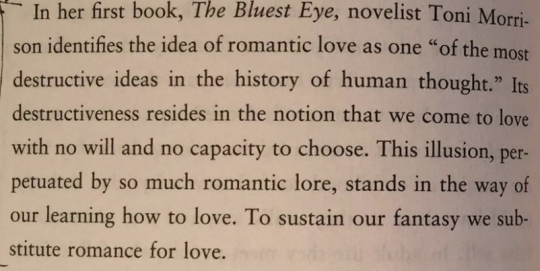
everyone in my life (facebook) knows right now that i’m revelling in ‘all about love’ by bell hooks. i put up a long quote from the book approximately once a day. i have been doing this since before i finished the book over three months ago. it’s that good. you should read it. i’ll buy you copy. seriously. i have bought six already and i’m contemplating getting copies in bulk. email or tweet at me.
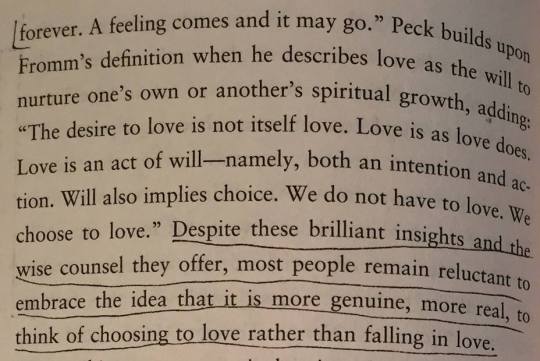
one of the concepts that stuck the most with me is the difference between falling in love and loving someone. hooks subscribes to the following definition of love from m. scott peck: “the will to extend one’s self for the purpose of nurturing one’s own or another’s spiritual growth.”
through the book, she expands and deepens her notion of love as action. and it’s a very specific type of action. it is different from care and it is most definitely not a feeling. given my upbringing in the christian tradition, this makes perfect sense to me. in fact, it clears up a lot of the confusion i had as a teenager about what jesus meant when he said to love all people.
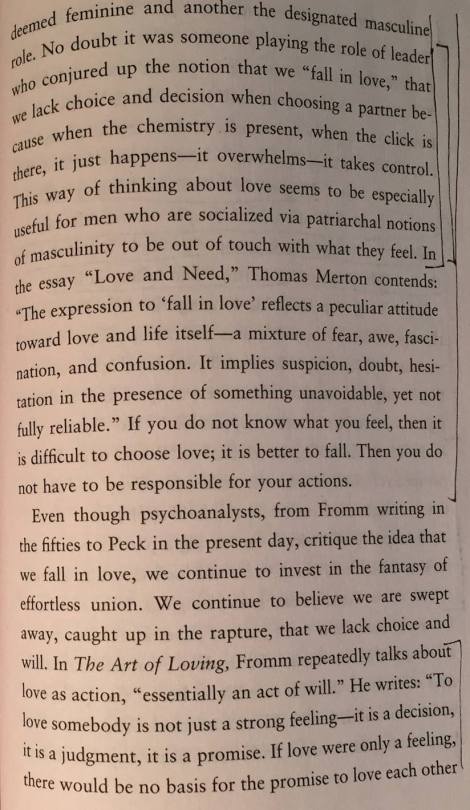
hooks takes it farther though. she believes that the ideas of "falling” or “being” in love are patriarchal constructs. at first, i was like ummmmm… but then i got it. she explains… (paraphrase)
“This way of thinking about love seems to be especially useful for men who are socialized via patriarchal notions of masculinity to be out of touch with what they feel. If you do not know what you feel, then it is difficult to choose love; it is better to fall. Then you do not have to be responsible for your actions. The language of having 'fallen’ gives the illusion that one is helpless during the process. It implicitly indicates that an individual is unable to be responsible for the situation, nor should they be. They have fallen and that’s that.”
it also gives the out that once the feeling fades, the relationship should end. because we (usually) can’t control our feelings, the loss of feeling means the end of the relationship. this is consistent with the helpless frame of thinking.
however, if loving someone means doing things that promote their growth, it actually has nothing to do with feelings and can persist even in voids of feeling. in fact, you could actually dislike someone and still love them.
this thinking isn’t new to me (shoutout to tallahassee christian youth groups - kumc, killearn lakes, calvary, etc.). but hearing it at this stage in my life in this way is rocking me and my world view.
:O
ps - an old co-worker, maanav, shared the five relationship stages framework with me. this framework provides some helpful complexity to this story. check it out. i mostly took from it that there is a significant transition between infatuation (stage 1) and the power struggle (stage 2). this, and the rest of the framework, map onto the hooks’ explanation of love really well, but i think that’s a different post. i’m already at twice my word limit. XO
pps - below are some links to relevant quotes from hooks and people she references regarding love.
the following details from prescott perez-fox interview really stuck out to me. basically, he says that a logo on its own might be nice, but it’s more or less irrelevant if it’s not integrated across the brand of an identity.
heavy paraphrased thoughts from the prescott perez-fox episode: “a single logo might be pretty but without a system, it’s basically just clip art. without the identity system, we don’t know if the client used it or if it successfully carried meaning across the brand / identity. a much more impressive thing is a simple logo with amazing system application. for example, h&r block is just a green square but when you see it applied everywhere in ways that make sense, it’s awesome.”
paula scher’s interview landed this particular point for me: identities are living, breathing things. the strength of an identity isn’t in the mockups, it’s in the world.
heavy paraphrased thoughts from the paula scher episode: “identities can never be judged at the moment they’re created. identity systems need time to live in the public. it takes a period of time for the public to digest an identity and also for the identity to have time to correct itself.”
the deeper i get into brand-thinking, the more i’m beginning to value the work of identity. it’s a complicated, but it seems the most talented designers strike a balance between predefined elements and guidelines within which future artists and designers can create.
supa cool.
shoutout to josh miles and obsessed with design; such an awesome show.