she mentioned a study that was aimed at finding out what made high-functioning people different from average people. the hypothesis: high functioning people exert more self-control daily than everyone else.
the findings, however, debunked that completely. turns out, high-functioning people actually exert less self-control daily than everyone else. the reason? habits!
gretchen went on to explain that the research showed people who were highly productive simply set their lives up to enable them to be productive. they removed as many decisions as possible from their day. this allowed them to do two things:
keep doing things that are good for them, even if they didn’t actively want to do them at the moment (for example, exercise).
save their decision-making energy for truly important things
in the research, the energy spent by the average person debating (i.e. what they’re going to eat, if they’re going to go to the gym, when they’re going to get a haircut, etc.) takes away energy from actually getting stuff done. of course, not to mention the fact that you may often decide to not do things that are good for you because you just aren’t feeling it that day. in the long-run, that adds up.
this all lines up really well with many different lines of thinking i’ve been having lately, but most directly it lines up with the cognitive budgets stuff. cool.
about a month ago i listened to an onbeing episode with david isay. among other things, david is the founder of storycorps. his interview, titled ‘listening as an act of love’ was super interesting and there are vast implications of his thinking about listening as core pillar of being loving, from the interpersonal scale to the societal and global scales.
but all that aside for the moment, one line in his interview really stuck out to me:
“i’m really good at collecting other people’s deep thoughts.”
because of what storycorps is, this was pretty tongue-in-cheek. that said, the reality of what it means to be a collector of deep thoughts is one that i feel like i live.
my whole life people have told me that i’m wise beyond my years. in some ways, i think this is mostly just a stance i take to the world. maybe it’s because it’s what comes naturally to me, but i think i do a really good job at cutting through the bs of daily life to identify and observe trends. i can recognize these trends over the course of a single friend’s life when i’ve known them for long enough, but also across different people’s lives. the combination of those two things enable me really latch on when someone is saying something deep.
sometimes the other person doesn’t even recognize the depth of what they’ve said. when i repeat it back to them, they’re often shocked at the gravity of their own statement (sidenote: is it the process of reflecting it back that adds gravity? who knows.)
anyways, these thoughts are a little all over the place, but one thing is for sure. i definitely feel similar to david in that i recognize that i’m a good collector of other people’s deep thoughts. does that in itself make me wise? i’m not sure. the dictionary definition of wisdom is about applying experience, knowledge, and good judgment. if the experience, knowledge etc is gathered from somewhere else, does that undermine my own wisdom? maybe. but maybe not. that said, if the knowledge gathered from other sources is invalid, what are books even for?
the other day ross said to me, “funny how you define something I’ve never really thought about myself, but now know.”
when he said that i realized yet another reason why relationships are so important. relationships teach us about ourselves in ways we could never learn without them. i wrote about several reasons yesterday, but the one i want to cover today is the johari window.
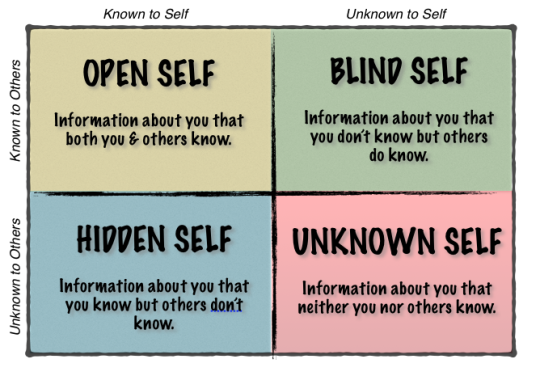
the johari window is a tool used to show groups and individuals how learning about the self and others happens over time. created by joseph luft and harrington ingham, the tool breaks down how we understand ourselves into four quadrants along two axes. the axes are ‘self’ vs ‘others’ and each axis moves from known to unknown. the quadrants of knowledge about ourselves are (clockwise from top left):
open self: information known by you and others
blind self: info about you that others know, but you don’t
unknown self: information that you and others don’t know
hidden self: information that you know and other don’t.
now, there’s a lot to say about this description model including how it helps individuals grow over time, how it can help teams work together more effectively, et cetera. what interests me about is it at the moment is it’s importance to relationships.
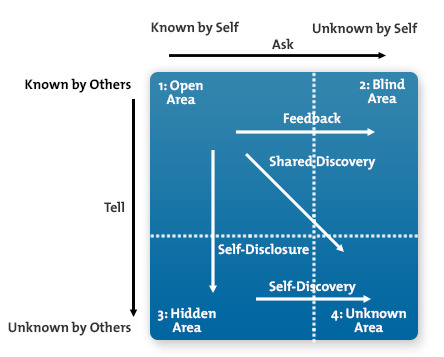
in theory, people who are strong leaders and partners actively work to minimize the size of the unknown self quadrant. this sounds like very much like the thinking on self-knowledge that gretchen rubin believes is part of the secrets to happiness. there are several ways to do shrink the size of this quadrant, but two of them involves others.
feedback is when people tell you things about yourself that they know and you don’t. being open to feedback is actually an uncomfortable and difficult thing. however, the more open you are to it (this takes practice and clear communication with others), the more likely it is that people will be willing to give you honest feedback and help uncover your blind spots.
shared discovery is when you and someone(s) else uncover something about you that neither of you knew. i have had this happen many times in work situations, especially when i’ve been on a team for a few months or years.
relationships matter because without them, there are some things about ourselves that we can never know. unsurprisingly, this thinking is consistent with many other parts of my thinking. having really thought through it, though, makes it concrete in ways that some of the quotes below reference more ethereally…
“Strangely enough, I can never be what I ought to be until you are what you ought to be. You can never be what you ought to be until I am what I ought to be.” — Dr. Martin Luther King, Jr.
last week, i wrote a post about sprinters and marathoners and how my friend ross and i fit into those roles. when i mentioned my think to him he said, …“funny how you define something I’ve never really thought about myself, but now know.”
when he said that i realized yet another reason why relationships are so important. relationships teach us about ourselves in ways we could never learn without them.
this fits into so many frames through which i’ve been thinking lately. it fits into bell hooks’ understanding of love and intimate relationship because being in a loving relationship with someone is actually a really hard thing to do [link to quote tumblr post]. though many of us are trained to want and seek love, most aren’t ready for it. hooks believes that being loved by someone means they are going to want you to grow [link to definition] and that means telling you things about yourself that they see as hinderances to your own progress.
and it also fits into my upbringing as a christian. love in christianity, at least in my understanding, is demonstrated primarily through relationships with people. love and relationship also show up in much of the christian writers i revered such as wendell berry, c.s. lewis, st. augustine, g.k. chesterton, and dietrich bonhoeffer.
finally, there’s this thing called the johari window which was going to be the full subject of today’s post, but i guess i’ll have to write about tomorrow…
one of the latest episodes of design matters is an interview with gretchen rubin. it’s a brilliant interview and a huge portion of it addresses her recent book on happiness (the happiness project). whether or not they seem to be trying to, almost everything in the conversation wraps back around to being happy.
of course, debbie (the interviewer) flat out asked what the secrets to happiness are. and, of course, nothing was incredibly surprising but it’s still worth sharing. there were many parts to the answer so here are the three that stuck out most to me.
answer part 1: once, when gretchen was working for supreme court justice sandra day o'connor, she asked the justice that very question: what’s the secret to happiness? justice o'connor, without missing a beat, responded “work worth doing.”
answer part 2: gretchen referenced several academic research studies on happiness. the threads that ran through them were (1) relationships and (2) self-knowledge. people who had strong, meaningful relationships and knew themselves well were the happiest over time. there are likely many reasons for that and i could write a whole post about each of those, but i’ll pass for now.
answer part 3: growth. for some reason, people are just happier when they’re growing something. over time and place, that has looked very different. sometimes it’s a garden, other times it’s a family, and other times it can look like an empire or a business. i would hope as we grow in consciousness about what it will take to make human life, we can all ‘grow’ things that are regenerative (instead of destructive) to the environment and each other, but regardless of what it is for each person, it makes a ton of sense to me that growing something is a critical part of being happy.
she also mentioned something about a happiness 'range’ and how to maximize it, but that seems like a post for later…