over the past few years i’ve started to truly appreciate the value of traveling. starting when i was in grad school, i began to take more and more trips. i traveled with friends, chosen family, and lovers.
regardless of who i was traveling with, though, i learned to prioritize waking up in another place. the process of going to sleep and waking up in another location really makes a trip feel different. i’m not totally sure why, but i have a few guesses.
first, waking up in an unfamiliar place breaks you out of your typical patterns. now, i’m all for routine to enhance productivity, but knowing when to break up your routine is an important part of having routines. that may sound counter-intuitive, but i’ve written about the routines (here and here) and also why getting out of them can spur creativity.
travel and waking up in a new place also is a reminder that the way you live your life isn’t the only way to live. whether in the wilderness or the suburbs or a city or a new climate, seeing a new day from another perspective is helpful for building just that: perspective.
i’m definitely not rich, but now whenever i travel, i try really hard to make sure i get at least one night and morning away from home. even if it’s just a quick trip to an airbnb one or two towns over, having 18 hours away where some of it is the overnight is more beneficial than getting up early and coming back lack on the same day.
how do the four criteria function together? here’s a little narrative that describes a few different ways that the four criteria work for me. this is internal monologue.
context
“ok. where am i? at work. great. i should only focus on things i can do while i’m physically at the office. i should also try to do things i want to keep dissociated from my home space. this means stuff that i could do here but could also do at home should wait.”
time available
“what time is it? 715a. my first meeting of the day isn’t until 11a which means i have almost four hours of uninterrupted work time. awesome! this seems like a good opportunity to get into flow [link to post about flow and creativity]. that means i shouldn’t let myself break up this time block into tiny chunks by having random convos with my co-workers, checking my email, or texting. let me find a quiet room where i can work without interruptions, put my phone on airplane-mode, and close down my email client.”
energy available
“ok, so it’s 415p and i have a really important deliverable due tomorrow at noon. that said, only have 30 minutes until my shuttle leaves and i’m mentally exhausted from my morning work session and the two afternoon meetings i attended. i should do something that needs to get done, but isn’t going to take a lot of mental energy.”
priority
“so in this 30 minute block of time before i leave the office, i could check my email or i could file my expense reports. my expense reports aren’t due until next week. i’m also waiting on an important message from a contractor. i should check my email and save my expenses for later. maybe if i finish my email, i could squeeze in the expense reporting. but if not, eventually, the expense reporting will be higher priority (more urgent) than anything else and it’ll get done then.”
it takes time to go through these four criteria at any given moment. i’ve found that taking the time results in significantly more productive days. that means i actually achieve my goals and consequently build confidence (because it feels great to set a goal and then achieve it). this positive feedback cycle simply cannot be underestimated.
just finished an amazing episode of onbeing with xavier le pichon. he’s one of the geophysicists who created the field of plate tectonics. he’s also “A devout Catholic and spiritual thinker [and] he raised his family in intentional communities centered around people with mental disabilities.” (from the interview web page). like many people i respect, there is little contradiction between his science and his faith.
the most incredible part of his interview was how he explained fragility. in his mind, fragility is what makes life pleasurable and enjoyable. this also lines up with chapter one of alan watts ‘the wisdom of insecurity,’ but that’s for another post. he started with this analogy.
in the earth, the closer you get to the core, the hotter it is. the deeper down you go, the more liquified the rock. at deep levels, molten rock and rock sheets are able to bend and fold, sliding over each other and deforming when they come into contact. at the earth’s surface, the same types of contacts cause violent disruptions: earthquakes, chasms, tsunamis, etc.
so, the softer and more malleable the rock, the more it’s able to flex and accommodate pressure.
the first level out of this analogy is to the individual person. people who are steadfast in their ways and thinking require big shake-ups to really make any change. those who are flexible tend to be able to go with the flow and evolve more easily.
the second level out of the analogy was to society. small, malleable groups of people or societies are able to accommodate changes in environment and circumstances fairly resiliently. empires, which tend to be large and well-formed (brittle), require revolutions or catastrophes to experience real, deep change.
ernest hemingway, an american author, believed that writing and editing are two fundamentally different processes. and because they’re so different, attempting to do both simultaneously meant doing neither well.
recently, i learned that john steinbeck, another american author, believed a similar thing:
“Write freely and as rapidly as possible and throw the whole thing on paper. Never correct or rewrite until the whole thing is down. Rewrite in process is usually found to be an excuse for not going on. It also interferes with flow and rhythm which can only come from a kind of unconscious association with the material.”
now, being the person i am, i took this idea to its logical extent. i tried (and failed, but still tried) to not ever go back to change words or fix errors when in writing mode. i just wrote and wrote and wrote until all the ideas were out on the page. only then would i go back, reread, and edit. it sounds a little counterintuitive, but it really worked.
part 2: the tools i use to writing hemingway style
i started off writing my thesis using a tool called draft. if i were using a standard word processor, i would have to use self-control to not go back and edit. hemingway mode on draft actually didn’t allow me to move the cursor unless it was to add a new letter to the document. and once you’ve got a clear goal defined, i’m all about removing the need to use self-control.
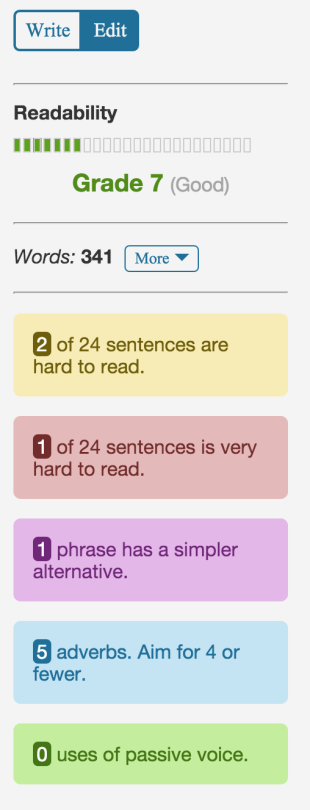
after my thesis, i stopped using draft, but now i use the hemingway app. i’ve written every post for this blog using it and i write other stuff in it as well.
the best part of it is that it tells me when i’m doing things that make my writing less clear.
anyway, tools aside, the takeaway is this: write first; edit later. it works.
i’ve been writing more or less consistently for six months. now when people ask me about it, i’m starting to share some of my tips and tricks. obviously, constraining myself to ten minutes has been a huge part of how i’m able to keep it up. another one is following hemingway’s advice on the difference between writing and editing.
another helpful tip has been to write to an audience of one. this one’s from john steinbeck (i heard the quote via some podcast and then copied the text from brain pickings):
Forget your generalized audience. In the first place, the nameless, faceless audience will scare you to death and in the second place, unlike the theater, it doesn’t exist. In writing, your audience is one single reader. I have found that sometimes it helps to pick out one person—a real person you know, or an imagined person and write to that one.
i think i started out doing this with my audience of one being my friend caroline howe. over time, it’s shifted to be become more granular. so instead of the whole blog being directed at one person, now i have one person in mind for each post.
often i actually send the post to the person after i hit post. and if i’m honest, one of the best things that has come out of this is that i can quickly send someone a chunk of my thinking. i’ve done this via text, twitter, and email and it’s so helpful to have things written down and in public.
i do wish i did a better job of tagging so i could send someone all of my posts about productivity for example. i should probably go back and do that… but time’s up for today so that’ll have to wait!