most people have life goals and dreams: buy a house, have kids, save for retirement, whatever. david allen calls these 50,000 ft. goals. unfortunately, we don’t really get good training on how to work consistently towards those goals over time. let’s put aside for the moment that goals like ‘saving for retirement’ are actually incredibly narrow-minded and mostly stupid).
fortunately, allen gives a great remedy for this. one of my favorite part of the getting things done (gtd) piece of methodology is the four criteria model for deciding what to do in the moment. it’s an important part of keeping your moment-to-moment decisions aligned with your big picture life goals. there are other parts of the gtd system that help keep daily activities aligned with life goals, but i’ll write about those later (preview: they include the weekly review and the all-encompassing project management system).
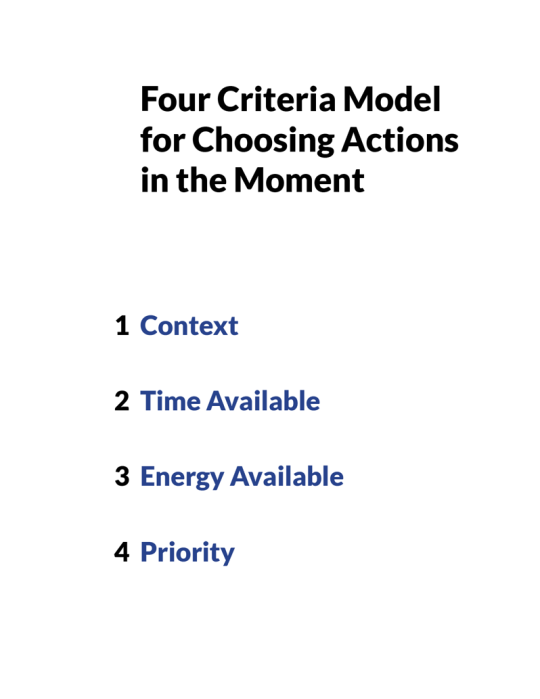
anyway, the four criteria model goes like this: in order to be the most efficient, whenever you need to decide what to do in a certain moment, use these four criteria in this order:
context
where are you? what can you do where you are that you can’t do anywhere else?
time available
given your context, how much time do you have available? if you only have 30 minutes, maybe you shouldn’t take on a huge, heavy-thinking task. if you have 3 hours, maybe you shouldn’t spend a bunch of it checking email.
energy available
what time of day is it? are you feeling rest and clear-headed? are you tired? have you made a bunch of decisions already today? do you not really feel like being productive?
priority
only now, considering your context, time available, and energy available, should you assess the priority of the things you could get done. of course, you should always handle the highest priority task… but only once you’ve gone through the other three criteria.
now, this was surprising to me at first, but now that i’ve been using it for over a year, i really understand how it helps me be productive almost constantly. these criteria (combined with other parts of the gtd methodology) allow me to feel totally confident from moment-to-moment that i’m using my resources most efficiently and doing exactly what i should be doing in the moment i have.
in several areas of my life right now, having a clear communication hierarchy has been great. and by communication hierarchy i basically mean a chain of command that determines how to communicate with someone based on the urgency of the message.
this all started because people kept (and still do) apologize to me for responding to my text messages days later. i couldn’t figure it out. to me, the whole point of texting is to allow asynchronous communication. and the value of asynchronous communication is that people can respond when it’s convenient.
this is in stark contrast to face-to-face communication. to respond to a comment days after someone said it to you in person would be rude. to do the same with a text, in my opinion, is not. that’s exactly how it’s supposed to work.
my personal, friends & family communication hierarchy looks like:
face-to-face convo
phone call
text
slack
tweet
email
physical mail
my work hierarchy looks like:
face-to-face
slack
email
phone call
now, it’s important to note that context is key. at work, maybe email has a really high place in the hierarchy and needs to be responded to immediately (honestly, i think that’s pretty destructive, but i know it happens in some work cultures). but for your friends and family, maybe phone calls have higher ranks than email.
and in some contexts, some tools aren’t or shouldn’t be used at all. for example, i try really hard to keep work conversation out of my text messages. when i don’t want to be working, i don’t want people to be able to or to have the expectation that they can text me to get me to respond to work matters. ew.
the point is, in whatever context you’re in, having a clear shared understanding of the ways to get in touch with someone based on urgency of request is important. and what do you do when an important message hasn’t been responded to via one method? move up the ladder and try another. and on and on until you get in touch.
but if you communicate with someone via top of the hierarchy tools for unimportant messages, you’ll create a sense of resistance and then itll be increasingly difficult over time to get in touch with them.
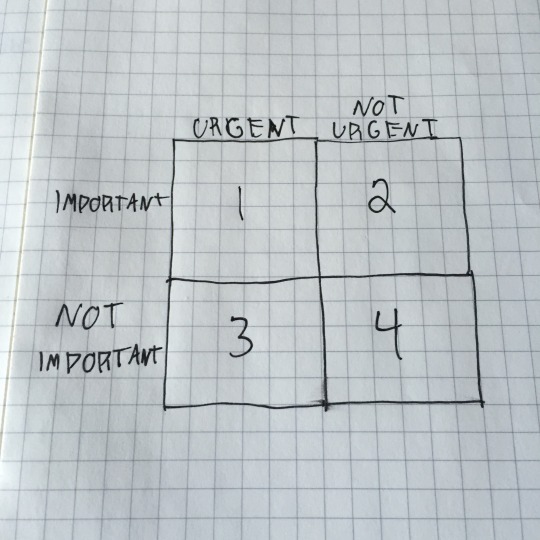
as the world becomes more notification-centric, the ability to discern between important, non-important, urgent, and non-urgent things is increasing. not only do individuals needs to be proficient at this, but as collaboration increases (because it’s the only way to solve some of the wicked problems we’ve got left or built for ourselves) it’s important for teams to proficient at this as well.
this post on mindtools has a really good explanation of the differences between each. it also has some tips about how to strategize in the long-term so that you get more important work done with less stress.
this post is about what happens when people fail to prioritize things properly. in my little sketch above, things are numbered in order of priority. to be honest, number 2 surprises most people, but i’ve found via my own experience that this is correct.
most places and organizations in which i’ve worked have problems with this prioritization. what happens is that everything that’s urgent is instantly classified as important and anything that’s not urgent is classified as not important. two classic examples are email and infrastructure.
email is almost always assumed to be important and urgent. this leads to people checking their email constantly. regardless of whether the new messages coming in are actually important or not, responses are sent quickly because the inbox is open all day in the case that something urgent and important does come in. however, this constant checking undermines focus, hinders higher-level brain function, and blocks flow.
in the long-run, this undermines an individual’s productivity. it also means they rarely get to the important but not urgent things, which typically slowly boil until they reach crisis mode. once in crisis mode, everything else must stop because now that issue/task has moved from important and not urgent to important and urgent.
the infrastructure issue happens all over america (education systems, roads, etc.), but in organizations this tends to look like social and technological infrastructure. tech is the one i see the most often. orgs will have obvious problems with their technology, but because people can still do their jobs, the work to the system is bypassed. it is classified non-urgent and non-important, which means it doesn’t get worked on. unfortunately, as the tech infrastructure problems build, people become increasingly frustrated and develop workarounds. soon enough, you have enough people with enough workarounds that even basic functions become difficult. you also often get to the point where people are frustrated enough with the poor infrastructure to abandon ship. it’s tragic to see poor infrastructure cause people to leave good organizations but it happens all the time. it happens in academia, government, non-profits, and more.
so the real trick is to figure out how to structure your (or your org’s) days and time so that you have time to work on the important but not urgent things as well as space to deal with urgent-important things (which are simply unavoidable because some crises are unpredictable) and urgent-not important things.
so dad has lost job and can’t get another one. some people at this point would say he should just retrain. he should take some time to learn a new skill and then he can find a job now that his old job is gone.
there are many things that make this difficult. first of all, the rate of change at which jobs are evolving is increasingly difficult to keep pace with. this, of course, is even more difficult as you age. can you imagine trying to teach a 50+ year old person who was on the road to retirement how to use twitter? sure, it’s possible, but it’s difficult. really difficult.
second, it’s not that the learning isn’t possible, it’s that it just doesn’t really make sense. once you reach a certain age, even if you can learn the skills, you just don’t live the same way because you grew up differently. even though my parents are on facebook, we will always use it differently because i’m a native to it and they aren’t.
finally, where those folks go to learn and gain new skills looks increasingly foreign. most people over 50 in america went to public schools that, more or less, were appropriate for the jobs they would work for their 30+ year careers. they also probably stopped at high school. nowadays, college is increasingly important and even colleges are failing at giving good educations. as long as we keep not investing in our public education systems, it’s only a matter of time before moocs (massively open online courses) and other education platforms take over. now try to imagine a 50+ year-old american learning in a mooc. it’s not impossible, but it’ll be pretty rough i imagine.
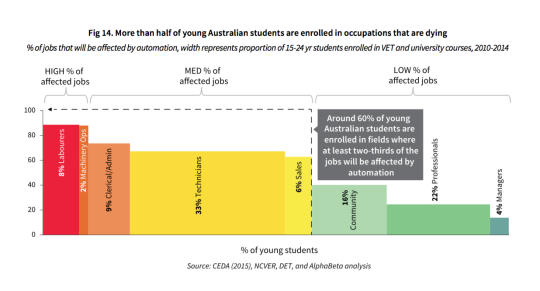
so that’s the problem with jobs and education at the older end of the spectrum. a few days ago, i got sent this report about the state of education for austrailians and it is not good.
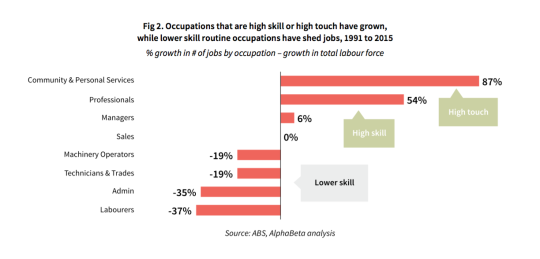
the report, the new work order (lolpunny) from the foundation for young australians, details that most australians are being educated for jobs that are (a) at medium to high risk of being automated away soon or (b) in sectors that are shrinking (related or unrelated to automation). some of those shrinking sectors are because of structural changes being made as developed economies shift from an industrial to service-based economies.
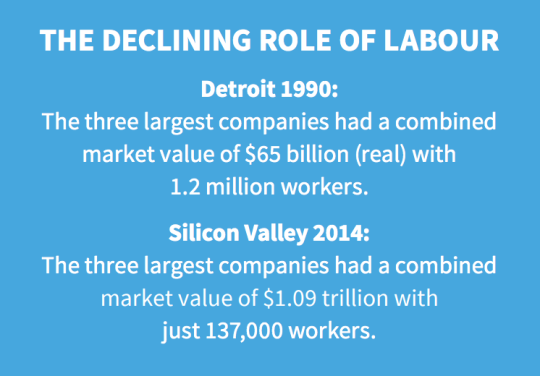
crazy facts from the report:
Detroit 1990:
The three largest companies had a combined
market value of $65 billion (real) with
1.2 million workers.
Silicon Valley 2014:
The three largest companies had a combined
market value of $1.09 trillion with
just 137,000 workers.
as the altschool founder said in this newco interview, the purpose of our education systems should be to prepare our children for the future. however, our current american education systems don’t do that. they are based on transfer of basic information in order to prepare workers for factory labor. this method of information transfer is irrelevant when students have (effectively) all of human knowledge in the palms of their hands. that said, schools don’t have to be that way (sugata mitra has a big idea about how to make that happen). could renovated education systems work for people of all ages? maybe…
but before going down that road…
to be continued… part 3: all that can be automated will be automated and what that means for the creative economy.
not quite sure where this is going, so a rambling we go…
this week during lunch, a friend explained how her dad ended up working at home depot. after he graduated form business school in his 20s, he went straight to work for a medium sized company. he was an upper-level manager at the company when it was bought out by staples. staples removed most of the upper management and replaced them with younger people who earned smaller salaries. dad went to an agency to help place him in another job. the agency basically said, “look: you’re too old to get another job with the same salary and benefits. no one is going to hire someone your age anymore. sorry.” dad becomes extremely depressed. he also stops hanging out with his friends because he became ashamed that he’s not working and making money. they used to play golf and travel and since his income stopped, he couldn’t keep up with the group’s social habits. the only place he could find a job was home depot. turns out, many of the other men working at home depot were in similar situations. they were managers, tech workers, specialists, etc., and were let go in the process of a company changing hands. this group has become a support group. no one likes what they’re doing, but at least the have each other.
this is the story of jobs disappearing. yes, some jobs disappear by shipping them overseas, but jobs that get shipped overseas tend to not be high-skilled. when companies buy each other, lay people off to downsize, and then never replace those positions, that’s how good jobs disappear.
why is no one talking about this? why aren’t republicans talking about how their get-rich-quick business practices are destroying middle-class jobs? their constituencies jobs?
next post: this report i just read details that most australians are being educated for jobs that are at medium to high risk of being automated away soon. and this statement: