a few months ago, a friend told me that the rate at which I’m able to integrate things is astounding. and just the other day, a different friend said something similar. i’m not totally sure what that means exactly, but i do know that i’m passionate about learning. and, i think my practices around saying no really help me learn. which is counter-intuitive… so let me explain.
back in february, i listened to an interview with eric zimmer. in the interview, eric references some research about how the pace of things nowadays actually keeps us from reflecting. even good content pieces on the best platforms encourage us to move to the next content piece as quickly as possible. just take a look at an article on any major media outlet webpage and count how many links you can click once you hit the bottom (some sites now just autoload other articles you might be interested in so that you don’t have to click or even stop scrolling). or think about how youtube videos now automatically play another video when they’re finished. and those are just a few examples of which there are many. intentionally or not, i agree with eric that the impact these techniques have our ability to integrate is significant. when we’re constantly moving through new ideas and information, it’s nearly impossible to really digest and decide what is worth bringing into your life and what isn’t.
later in the interview eric gave an example of one way to switch this pattern. someone suggested taking just five minutes after consuming (watching, listening, reading, whatever) a piece of content to think about what to do with what you learned. i think that’s a brilliant suggestion.
and i can already imagine myself resisting taking the time to reflect and process. honestly, i think that makes me want to commit to it more (it also gives me a (another) great excuse to not try to read or watch everything. we’ll see how it goes.
i am a person who identifies (and has been identified by others) as a connector. so it’s from that stance that i wonder if it’s possible to be over-networked.
i’ve been thinking about this a lot lately for two reasons.
first, i keep hearing about the limits of human connection. there’s some interesting, research (mostly coming from dunbar’s number research in the 1990s) about how the human brain can only meaningfully hold a certain number of people. after about 200 people, our brains begin to function worse when it comes to retaining information related to those people. so at a certain point, this means we actually can’t “know” more people. or at least, not well…
second, i notice in myself a diminishing desire to go to ‘networking’ style events. well, i actually never liked events with that explicitly language, but still… i find myself resisting events with large amounts of new people and focusing on ones with more (or all) people i already know.
given those things i’m starting to wonder if (in this digital age of social networks) being over-networked is a genuine possibility. i imagine at a certain point (maybe size of network), there must be a tradeoff between the time spent building a network versus time spent strengthening your existing network and/or utilizing it to get things done.
i think being over-networked might show up in a few different ways. the two that first come to mind are:
people who are “bad” at names are often super connected. (note: i only have anecdotal evidence about this).
people (myself included) forget important or key details about people what we genuinely care about. consequently, there is now a small market of apps built specifically to help us remember people we meet. (example 1, example 2, example 3) weird, eh?
anyway, i’m still not sure if being over-networked is a real thing. either way, i’m keeping my eyes open for other signs of this phenomenon in my life and in others. sure, i think some people really are meant to connectors; that’s the passion and value they bring into the world. however, i think more of us have networks that are untapped and just oozing with potential. i’m becoming increasingly interested in figuring out how to mobilize the potential for good.
over the course of my life, i’ve developed some pretty rigorous thinking about how i work. every few weeks someone asks me about a personal system i’ve developed and this piece is for them. i’ve picked up a few different key tools from a range of methodologies so here’s a quick rundown. each of these summaries is the tip of an iceberg. at some point (hopefully) i’ll expand how each influences my workflow later… but for now, the summaries.
getting things done by david allen
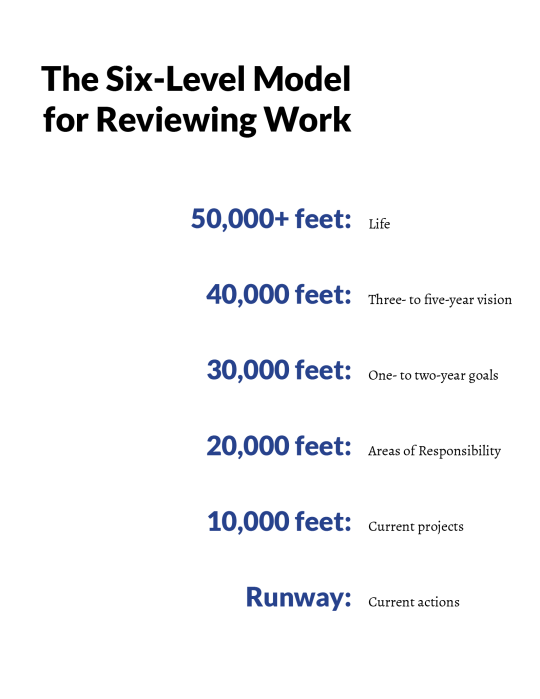
have a comprehensive system to track EVERYTHING that requires action in your life. this includes work, side projects, and personal things. there are many specific practices that i use (with varying levels of success, heh) including: the weekly review, the ‘next action’ and 'waiting for’ task labels, the six-level model for reviewing work, and the 4 criteria for choosing actions in the moment.
six things the most productive people do every day
dividing work sessions (even “uninterrupted” morning work sessions) into pomodoros helps keep me focused while keeping me honest about how long tasks take. it also gives me five-minute breaks to get up and walk (and it’s pretty old news now that walking is good for creativity and has all sorts of other positive effects).
flow
flow, sometimes called zoning, is when working on something takes such intense focus that you are consumed by it. entering flow is a tricky thing (especially for managers because of maker time vs manager time) but setting myself up to get there is both productive and makes me FEEL productive. and feeling productive has great momentum-building effects on the rest of my day and upcoming days.
good to great
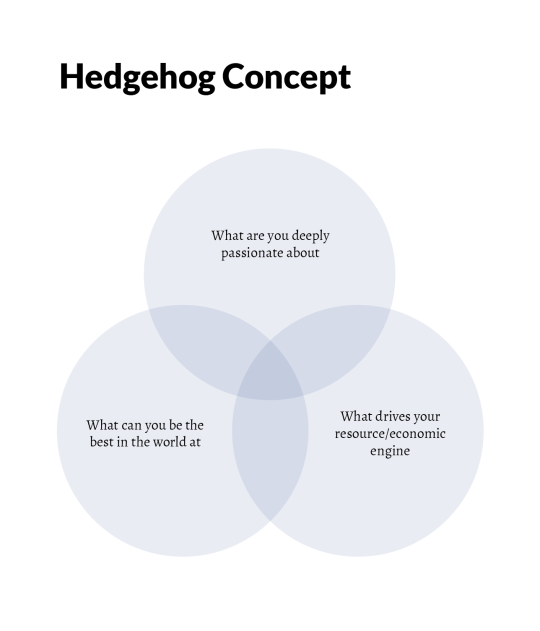
several concepts here are useful, but the one that impacts me the most is the hedgehog concept.
working to refine my person hedgehog concept is a continuous process. but the hedgehog conceptual frame helps me assess where i’m going and how to get there. super helpful, especially combined with the 50,000-foot view from getting things done.
there’s a quote in getting things done to the effect of 'if you aren’t thinking about how you’re working, you’re no longer in control of your work’. i subscribe to that line of thinking wholesale.
i could talk about productivity all day so if you want to talk details, get in touch!
note: both graphics in this post are just my stylized adaptations of concepts from their respective books. nothing new here.
basically, every time you make a decision, it uses up some mental capacity. mental capacity is a finite resource. this means that everything you do over the course of a day (including decisions) takes up some of your daily ‘cognitive budget.’ if you make too many decisions in a day, you experience decision fatigue. decision fatigue, for me, looks like massive productivity slow downs.
i love these ideas. they explain so much of the commonality between all the different work flow research and theory. they also explain why not sticking to my work flow structures makes things fall apart. examples:
do your most important work of the day before you have a chance to be interrupted. processing interruptions requires decision-making, even if the decision is to defer or ignore.
when i have morning meetings, my days are less productive. meetings eat up a lot of cognitive budget. hence my allergy to morning meetings.
scheduling menial tasks for in the afternoon keeps my mornings focused on solving complex problems. my brain literally doesn’t have energy to handle these late in the day.
picking out clothes the night before.
anywho, more to come about this (and the all-important connection to routines) later. in the meantime, this blog post from barking up the wrong tree has lots of relevant research and thinking. it changed my life.
today i met up with one of my favorite fraternity brothers. we talked about a lot, but one of the topics was about lessons learned from living together.
he said this, “if there’s one thing i learned from living in the [fraternity] house it was how to live and function with people who had fundamentally different world views than me. i might have major disagreements with them, but because we live in the same place, we still figured out how to work together.”
his statement reminds me of several conversations we’re having at work right now. one of them is the belief that people, in spite of their diffrences, can come together and collectively make the world a better place for all of us (we call this big democracy). the other is a question i’ve been holding about our work: “how close do two or more people need to be in order to be honest about their beliefs but still keep moving forward together? how much do i need to know someone else in order to genuinely respect them and, if we disagree, still keep working them towards some goal we do share?”
in the age of the internet and ever-polarizing politics, it’s easier than ever to seclude oneself from dissenting opinions. this can look like: defriending/unfollowing people who disagree with you, only following/friending people who agree with you, only consuming news media that, generally, agrees with your point of view, etc.
but that, honestly, just doesn’t seem like a legitimate pathway forward.