writing my masters thesis was the beginning of my personal systems and productivity transformation. it may or may not have happened at the same point in my life, but definitely attribute my attention to my workflow and productivity to the magnitude of the task. having been through the undergraduate program in my department, i got to know many masters students. i also got to watch two years of students go through what looked like hell as they wrote their theses. the spring semester of everyone’s final year seemed like an incredibly isolating, depressing, and terrifying time.
i wanted the masters degree, but i was determined to avoid that experience at all costs. hence, i tried to get as much advice and pick up as many strategies as i could before i went into it.
although i learned a lot and built many important habits during the process, two specific ones really changed the game for me.
first, i realized how important it was to have a thesis buddy (huge shoutout to annemarie gray). we committed to getting up at 6a almost every day starting in early 2016, getting to a coffeeshop by 7a, and writing for 2-4 hours. we did this for months. we even had a hashtag for our instagram posts: #thesismornings!
having the accountability and support of a partner was unbelieveably important for me. on days that i didn’t want to get up, hearing annemarie getting ready made me do the same. and i knew that if i wasn’t ready to go so that we could get to a coffeeshop when it opened, i’d feel real bad.
so, having a buddy totally changed how i view and understand accountability. i always knew it was important, but this took it to the next level. especially since it lasted for months. this understanding about accountability has influenced the international writers group i’m trying to grow these days (shout out to cameron russell and janani for the inspiration on that one!) and also my decision to join my friend ross as a co-founder of jungle).
and second habit was the pomodoro technique. so many good things came from pomodoroing:
the practice of dividing my work into chunks helped me get realistic about how long each step of the process was actually going to take.
working for uninterrupted blocks of time and then doing whatever i wanted during the break times made me realize how much more effective i was when i could focus. that also helped me realize how detrimental interruptions are to my productivity. even the smallest interruption can be totally destructive to certain types of work.
learning how to notice when my heavy-thinking energy had been used up made me understand the value of working with my body’s systems and not against it. having pomodoro chunks of time made it very obvious that 25 minutes of writing at 7a was sometimes 2x more productive than 25 minutes in the afternoons and sometimes 3-5x more productive than writing at night. this made it much easier for me to justify to myself and others why i needed to not have morning meetings.
learning how doing something physical during the 5-minute breaks kept me productive during the 25-minute sessions has made me integrate walking and stretching into all my workflows.
observing how critical these two changes were to me completing my thesis in a low-stress manner kickstarted my productivity journey. things have never been the same and they’re definitely only getting better.
some goals are themselves the reward. making dinner meals on sunday nights for the week is one of those types of goals. doing the work on sunday night pays off during the week when you have food already made.
other goals require a little more indication of success, especially if the goal is less immediately tangible or is a piece of a larger goal. for example, keeping track of all your receipts for a year. the payoff for that might be a stress-free tax filing process, but week to week there’s no feedback.
regardless of which type of goal you’re working towards, setting up rewards for yourself is clutch. it’s especially clutch during the habit formation process.
example: sometime in 2015, my dear ex-roommate, annemarie, and i set out to read more. we did several things push us towards our goals.
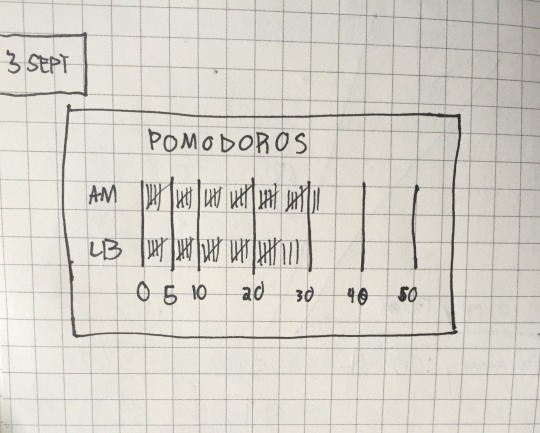
first of all, we build a concrete system with specific metrics to track our progress. we both like to work in pomodoros (which we learned to use during the process of writing our masters theses) so we said we’d like to do fifty 25-minute chunks of reading.
second, we set out to work towards the goal together. it created some accountability (which was best for me) and also some competition (which works well for her).
finally, we created rewards for ourselves. we both really wanted new small backpacks for short trips. i can’t remember if she wanted the same kind, but i definitely had my eyes on a fjall raven backpack (i’m really into buying high-quality stuff with lifetime warranties these days ‘cause fuck planned obsolesence). if we hit the goal, we’d each buy ourselves the backpacks.
in the end, we actually moved out before either of us hit our goal, but i’m still working towards my goal. i’m only a few tallies away… maybe because of this post, i’ll finish today.
ps - i made the little chart below (this is a sketch because i can’t find the original) and we each recorded tallies to keep track. it was definitely fun to come home after a day or weekend apart and boast to each other how many tallies we got to write up.
the bad news is that change is hard. always has been and probably always will be. in my experience, personal systems change is one of the hardest types of change to make. most people have built their current habits and practices over a lifetime. a habit built and maintained over years is not easily broken.
the good news is that change hard! as it is with all double-edged swords, once a habit, good or bad, is built, it’s much harder to break it.
so, in my own personal systems, i’m all about finding ways to break old habits and build new ones.
so here are two tricks that i’ve used on myself and seem to be helpful to other people.
first, in line with my favorite buckminster fuller quote about change, i think the best way to break an old bad habit is to replace it with a new good habit. lots of people i know, myself included, have addictive personalities. this means when we get into something, we really get into it. that makes it much easier to take on a new good habit (say reading a book a week) than it is to try and kick a bad habit (say binge-watching an entire tv show a week). and making new habits stick is easier when you’ve set up some rewards and/or positive feedback cycles in the new habit.
accountability is HUGE in making change stick. many people vastly undervalue and underestimate external support and validation. however, i’ve seen (and experienced) that just knowing someone is watching or cheering for you can make the difference between success and failure of a new habit.
accountability can show up in many ways. some methods i’ve used on myself and with others are: (a) letting someone else know your goals and then checking in with them about your progress, (b) asking someone else to check in with you regularly about your progress, and (c) committing to something with someone else and supporting each other in it.
change is hard. the more ways to make it easier, the better.
ps - i’m also testing a combination of (a) and (b) which is that you try to check in with someone about your progress and then if they don’t hear from you, they should actively ask you how it’s going.
i think this idea came from getting things done, but i’m not sure. one crazy thing about the way our brains work is positive feedback mechanisms. the more we can use these to our favor, the better.
now before getting too deep into this, a positive feedback loop isn’t necessary one that is “positive” in the most common sense of the word. it technically means that one action triggers the pathway to more of that action. a stampede is a result of a positive feedback loop as is eating at a popular restaurant. this is opposed to negative feedback loops in which an action triggers less of that action (more on that over here).
ok so what implication does positive feedback have on feeling productive? basically, when you feel like you’ve accomplished a goal, this triggers a release of certain chemicals that makes you feel good. most people have experienced this. most people have also experienced the reverse of this. when you don’t accomplish a goal, you feel bad and can even be demotivated.
both of these pathways are positive feedback loops. so how could you use that to be more productive? set the bar for success really low and make sure you can hit it. over time, you will build confidence, concrete knowledge of your ability to do that task, and you’ll also probably improve at it. then, you can slowly move the bar for success further and further so that you’re doing more, better.
example: in january of this year, i set out to write for ten minutes a day with a 200 word-cap. i wasn’t 100% successful, but by my six-month self-check in, i had 47 posts. i also noticed that i had, completely naturally, increased the amount of time i was writing everyday to 20 minutes. i think this is because i was getting more confident about my abilities and, because of that, i had more that i wanted to say. and more recently (just last week), i hit my 100th post for the year and i’m up to 30 minutes per post (including writing and research).*
now, if i had said to myself in january, write 100 blog posts by sept, i imagine my likelihood of success would have been very low. but because i set the bar from the other direction, i felt little successes along the way, i’ve got 100+ posts, and now it actually feels weird to not write. in fact, this is my second post today and i’m probably going to write two more before 10a (it’s 9:30a).
being strategic about making myself feel productive has been massively important for my productivity. and i’ve seen it work for other people, too.
this piece of advice has completely revolutionized how i approach the world. i wish i could remember exactly where it came from. that probably means it’s mashup of a few different ideas (curtis ogden’s general approach to blogging, harold jarche’s piece on his inspirations for working out loud, the platform revolution’s “good ideas are public domain” quote, etc.).
anyways, the point is that almost everything is better out in the world than in your head. this applies to pretty much everything: raw ideas, partially developed thoughts and theories, drawings, et cetera.
i’ve noticed in my productivity coaching practice (i’m up to four clients as of today!) and also in my life that most people are just really resistant to publishing. there are many sources of fear. self-critique is the overarching, but that can present in a number of ways. sometimes its a fear of not being good enough for others (check out ira glass talking about the difference between your skills and your taste), sometimes it’s the fear that it won’t even be as good as you think it was in your head, sometimes it’s a fear of theft.
either way, the reasons to get it out anyways are three-fold.
first of all, just putting something out into the world puts you way ahead of most people. again, because most people face the fear and never overcome it, just taking that first step is huge.
second of all, even though the thing you put out likely won’t be perfect or what you wished it was, most people started out sucking at their thing before they got good at it. this is a recurring theme on the obsessed with design podcast and was heavily featured in this week’s episode with bob ewing.
once you put something out there, the people who you look up to at your thing can give you concrete and constructive critique. and while self-teaching is always possible, the more guidance and constructive feedback you get, the faster your growth pathway will be.
so. get your shit out of your head and into the world.
the quotes:
Dude, suckin’ at something is the first step to being sorta good at something. —jake, adventure time